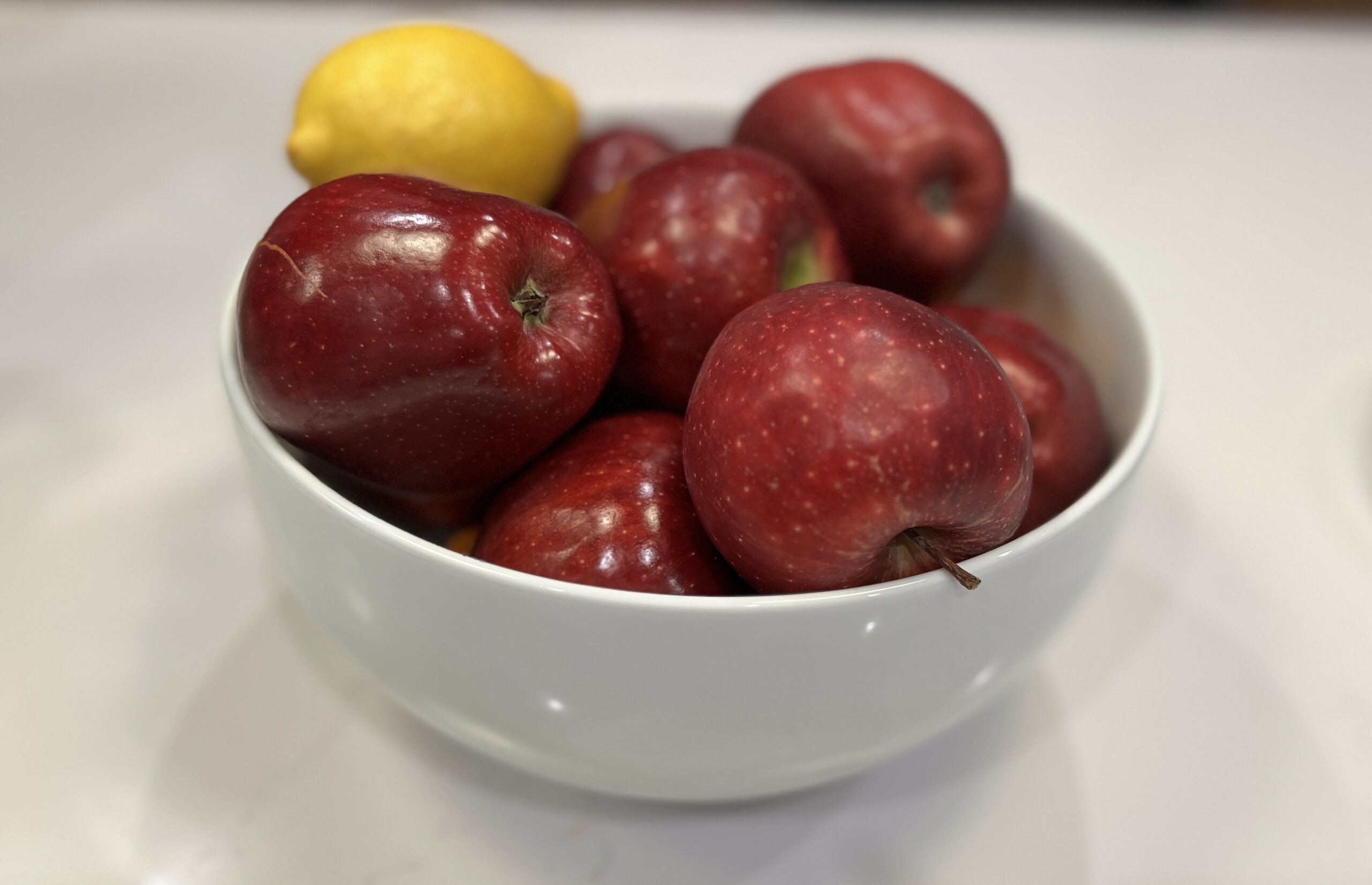

Looking for the best way to make applesauce from Red Delicious apples? This guide explains why the much‑maligned Red Delicious is actually ideal for smooth, naturally sweet applesauce. With step‑by‑step instructions, kitchen science tips, and altitude adjustments, you’ll learn how slicing versus dicing changes texture, why density matters, and how to make a sugar‑free version that’s even dog‑friendly.
Welcome to the Apple Series
This series is a deep dive into the world of the apple, organized into three main features:
- The Science: Biology, nature, and climate.
- The Cultivation: Breeding, growing, and harvesting.
- The Culture: Mythology, art, and global trade.
But we start in the kitchen (The Science) with a knife, a pot, and a simple question about shape.
At a Glance
- The Myth: The Red Delicious apple is too soft for cooking.
- The Truth: Its soft structure makes it perfect for a smooth, sugar-free sauce.
- The Showdown: We compare Slicing vs. Dicing. Does cutting smaller pieces actually speed up cooking? The result surprised us.
- The Secret: It’s about the shape of the cut. Thin slices let heat pass through instantly; thick cubes act like bricks.
Table of Contents
The Apple, Hiding in Plain Sight
The apple is often overlooked precisely because it is such a common sight.
It is universally enjoyed in meals, desserts, and snacks. It is a favorite subject in art, appearing in centuries of still-life paintings, and it serves as the quiet, central theme of home decor in kitchens everywhere. Because this “low key” fruit is so familiar, we stopped really looking at it.
But if you look past the skin and the stem, the apple is a world of complexity. It is a biological anomaly that refuses to grow true from seed. It is a traveler that walked its way from the Tian Shan (“Heavenly Mountains”) mountains of Kazakhstan to the orchards of Washington state.
The Secret to Texture and Sauciness
Most recipes tell you what to do, but they rarely tell you why. We are going to look at why the texture of your applesauce isn’t just about the type of apple you buy, rather it’s about the shape of your cut.
The Challenge: Redeeming the Red Delicious
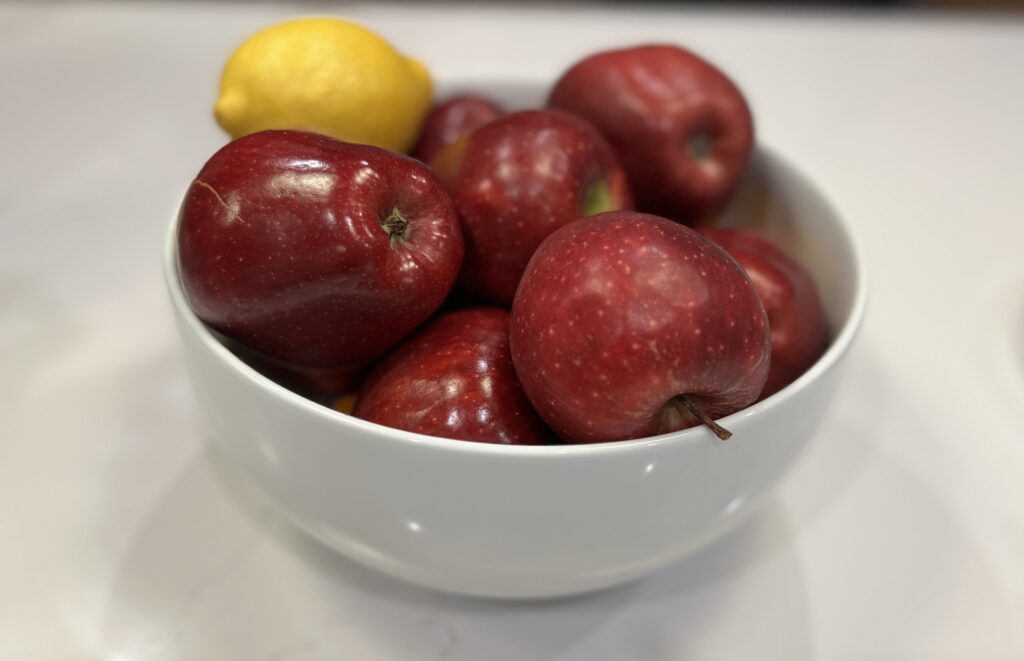
The Red Delicious apple’s popularity has declined significantly over time. It used to be the king of the lunchbox, but nowadays it often sits untouched in the produce aisle as shoppers reach for crunchier, more modern varieties. But for applesauce, that soft structure is actually a significant advantage.
Because Red Delicious apples are naturally soft (that “mealiness” often criticized in raw snacking), they don’t just cook; they surrender. They collapse into a puree much faster than a crisp Honeycrisp would. By adding one Granny Smith, we introduce a “structural” apple to provide body and tartness to balance the sweetness.
The Golden Ratio
Standard kitchen wisdom suggests using 2 cups of water for every 8 apples. Since I was working with 7 apples, I adjusted the hydration using simple proportions:
The result is a sauce that wasn’t watery or dry. It was perfect.
The Freedom of Ratios
Understanding ratios is one of the most valuable skills in the kitchen. It grants you the freedom to cook without being tethered to a recipe card. Whether you have three apples left in the fruit bowl or a bushel of thirty from the orchard, the ratio remains the same. This allows you to scale your batch up or down effortlessly while guaranteeing the perfect texture every time.
The Method: Prep & Technique
Before we cut a single apple, we have to prep the pot to maximize flavor and color.
1. The Microwave Step (Heat) I started by poking two holes in a lemon and microwaving it on HIGH for 15 seconds.
- Why? Microwaving excites the water molecules inside the lemon. As the molecules vibrate, pressure builds and bursts the juice sacs. When you slice it open, the juice flows out with almost zero effort.
2. The Bath I sliced the lemon, squeezed the juice into the pot, and added the 1.75 cups of water before cutting the apples.
- Why? By creating a lemon-water bath first, I could toss the apple pieces in as I cut them. This coats them immediately, preventing oxidation (browning) on the first apple while I am still peeling the last one.
3. The Cook (The Timeline) I didn’t use an immersion blender. They are bulky, and frankly, I find the idea of plugging an electric device into a pot of boiling liquid a bit risky. This meant my applesauce had to rely on heat and time to break down.
- 0 – 20 Mins (Steam): Cook on medium-high (until boil), then lower to medium, covered.
- 20 Mins: Remove lemon rinds.
- 20 – 45 Mins (Simmer): Lower heat to medium-low to reduce the sauce.
Note on Altitude
I cooked this at sea level. At higher altitudes, water boils at lower temperatures because of reduced air pressure. This means the water may appear to boil sooner, but it is physically cooler than it would be at sea level. As a result, foods take longer to cook. If you are at higher elevation, you will need to extend the simmer time or use a pressure cooker to compensate.
Example:
- Sea level → boils at 212°F (100°C)
- Denver (~5,000 ft) → boils at ~203°F
- 10,000 ft → boils at ~193°F
- Altitude Check: To avoid undercooked apples and adjust your simmering time accurately, use our Water Boiling Point Calculator to find your true local boiling point.
- Time Adjustment: You may need to add 15–25% more time to achieve the perfect sauciness.
The Setup: A Pound is a Pound
Before we pick up the knife, let’s look at what we are actually cutting.
If you buy one pound of apples, you have a specific amount of fruit flesh, this is volume. But how do we measure it without dunking apples in a bathtub? We use density.
- Water has a density of 1.0 \text{ g/cm}^3 .
- Apples float. This means they are lighter than water. Because about 25% of an apple is air, their density is roughly 0.8 \text{ g/cm}^3 .
- One pound of mass equals 454 grams.
Using the formula \text{Volume} = \frac{\text{Mass}}{\text{Density}} , we can find the exact space our apples occupy:
V = \frac{454}{0.8} \approx 568 \text{ cm}^3
No matter how you cut them, slices, cubes, or wedges, the total amount of apple in the pot doesn’t change. It’s always the same size “pile” of fruit. However, how that pile behaves in the hot water changes completely depending on the shape of your cut.
The Theory: Does Smaller Mean Faster?
Here is the general rule of cooking: More exposed surface area = Faster cooking.
Think of it like ice. A giant block of ice takes forever to melt in your drink. But if you crush that same ice into slush, it melts instantly. This is because the heat can touch more of the ice at once.
As your apple pieces get smaller, the total surface area increases rapidly.
Where did 3408 come from? It is the volume of our apples (568 \text{ cm}^3) multiplied by the 6 faces of a cube. This number represents the total potential surface area locked inside our pound of fruit. The formula tells us that as the pieces get smaller (x) , the exposed area (A) gets bigger.
- Big Chunks: Very little surface area exposed to the heat.
- Tiny Mince: Massive amounts of surface area exposed.
The Prediction: Based on this math, dicing the apples into small cubes should be the fastest way to make sauce. The heat should attack all sides of the cubes and melt them down in record time.
Use the interactive charts below to compare the three methods. Click on the lines to see the differences.
- The Red Line (Cubes): Notice how high this line is. Logic suggests cubes expose the most fruit to heat.
- The Yellow Line (Slices): This line is lower. Theoretically, slices expose less fruit to the heat.
- The Green Line (Grate): This creates the highest surface area possible.
The Showdown: Theory vs. The Real World
I ran the test, Dice vs. Slice, and tracked the breakdown over a full 45-minute cook time at sea level. The results completely contradicted the math chart above.
The Plateau (Minute 30) Logic says the smaller cubes should have melted by now. In reality, at the 30-minute mark, both the cubes and the slices still held their structure. Neither had turned into “sauce” yet.
The Divergence (Minute 45) This is where the geometry finally mattered, but not in the way we predicted.
- The Dice: Even after 45 minutes, the cubes remained as distinct chunks. To get a smooth texture, I had to use “elbow grease,” mashing the softened blocks against the side of the pot.
- The Slice: In the final 15 minutes, the slices surrendered naturally. They broke down into smaller, uniform bits that stirred easily into a smooth, golden sauce without heavy mashing.
This second chart tracks the “Sauciness” (breakdown percentage) over time.
- The Red Line (Dice): Notice how it flattens out. The cubes got soft, but they refused to break down.
- The Yellow Line (Slices): Notice the surge at the end. Even though slices had less surface area, they melted into a sauce much better.
- The Green Line (Grate): Instant sauce – 100% breakdown from minute one.
Flavor: Why No Sugar?
Finally, we have to talk about color and flavor.
The Lemon (Color Protection) An enzyme inside reacts with the air and turns the apple brown. Lemon juice stops this rusting process in two ways: it creates an acidic shield and acts as an antioxidant to keep the fruit bright.
- The Acid: The sourness (citric acid) creates a shield. If the apple surface is too acidic, the enzyme shuts down.
- The Vitamin C: This acts as an antioxidant, chemically reversing the browning process before it becomes visible.
The Salt (Flavor Potentiator) You might notice salt listed as an optional ingredient. It shouldn’t be.
- The Logic: Salt helps draw moisture and natural sugars out of the fruit’s cells.
- The Taste: More importantly, salt suppresses bitterness. By knocking out the bitter notes, your tongue perceives the fruit’s natural fructose more intensely. This is why a pinch of salt can “draw out the sweetness” without adding a single grain of actual sugar.
The Rule of Thumb: You don’t need a gallon of juice. For my 7-apple batch, the juice of one large lemon was the perfect amount to coat the slices and keep them bright without making the sauce taste like lemonade.
Summary: The Verdict
We started with a simple question: What does shape got to do with sauciness? but we ended with a practical lesson in cooking.
| Variable | The Dice (Cubes) | The Slice (Winner) | The Grate (Instant) |
| Cooking Time | Slow. Thick centers act like bricks, resisting heat even at 45 mins. | Fast. Thin profiles let heat pass right through. | Instant. Cells are destroyed before cooking. |
| Texture | Lumpy. I had to mash the chunks by hand. | Uniform. Collapsed naturally into a smooth puree. | Liquified. Dissolves into a wet mash. |
| Color | Darker. Tumbling cubes got too much air. | Golden. Stacking slices stayed protected. | Variable. Oxidizes very quickly. |
| Effort | High. Lots of stirring and mashing. | Low. I just let the heat do the work. | Medium. Grating is messy work. |
Unless you own an immersion blender, put away the dicing knife. If you have a mandolin, this is the time to use it. Thin slices surrender to the heat, giving you a golden, uniform sauce with a fraction of the effort.
Bonus: A Treat for the Pack
I didn’t just make this applesauce for myself. I made it for my dogs.
Because this recipe relies on the natural sweetness of the Red Delicious and the tartness of the Granny Smith, with zero added sugar, it doubles as a fantastic, healthy food topper for pets. Commercial applesauce is often loaded with high-fructose corn syrup, which is terrible for canine dental health and weight management.
This batch is pure fruit. It’s a great way to add moisture and fiber to their diet without the additives that lead to plaque buildup.
Want to know more about keeping your dog’s teeth healthy? You can read my latest deep dive on why diet is the first line of defense against dental disease here: Your Ultimate Guide to At-Home Dog Dental Care (Our Secret to Avoiding $1000 Vet Bills)

Sugar-Free Applesauce (The Shape Method)
Ingredients
Equipment
Method
- The Lemon Prep: Poke two holes in the lemon and microwave on HIGH for 30 seconds. Slice in half and squeeze the juice into your pot. Toss the empty rinds into the pot as well.
- The Bath: Pour 1 ¾ cups of water into the pot with the lemon juice. This creates an acidic bath to prevent browning.
- The Cut (Slice Method): Cut the bottom of each apple to create a flat, stable surface. Peel, core, and cut into 1/8-inch thin slices (not cubes). Immediately toss slices into the lemon water as you work to keep them white.
- The Steam: Cover the pot. Turn heat to Medium-High until the liquid boils, then lower to Medium. Cook for 20 minutes.
- The Simmer: Remove the lemon rinds. Lower heat to Medium-Low. Simmer uncovered for 25 minutes.
- The Completion: The slices should have surrendered into a smooth sauce. Stir well to break up any remaining bits. If the sauce is too thick, add water 1 tablespoon at a time until perfect.
Notes
Stay tuned: In Part II, we’ll explore how biology and geography work together to create the apple in the first place.
References
- American Kennel Club. (2024, February 21). Can dogs eat apples? https://www.akc.org/expert-advice/nutrition/can-dogs-eat-apples/
- Duan, N., Bai, Y., Sun, H., Wang, N., Ma, Y., Li, M., Jepphesen, X., & Chen, X. (2017). Genome re-sequencing reveals the history of apple and supports a two-stage model for fruit enlargement. Nature Communications, 8(1), 249. https://doi.org/10.1038/s41467-017-00336-7
- Engineering ToolBox. (2003). Food densities. https://www.engineeringtoolbox.com/water-content-d_131.html
- Held, L. (2015, January 13). Why do apple slices turn brown? Scientific American. https://www.scientificamerican.com/article/experts-why-cut-apples-turn-brown/
- McGee, H. (2004). On food and cooking: The science and lore of the kitchen (2nd ed.). Scribner.
- University of Illinois Extension. (n.d.). Apples and more: Apple facts. https://web.extension.illinois.edu/apples/facts.cfm