
A complete reference for knitters working across lace, everyday garments, jumbo projects, and everything in between.
Accurate knitting needle size conversion is essential for matching gauge, substituting needles, and working with patterns from different regions. This guide covers every US needle size from 0000 to 85, including hard‑to‑find mid‑sizes like US 2.5 and US 10.75, plus the extreme jumbo range used in arm knitting and oversized projects. Each table includes exact metric equivalents and the typical gauge per 4 inches (10 cm) to help you choose the right needle for your yarn and project.
Table of Contents
Complete Knitting Needle Size Conversions Chart
Whether you are using circular needles, DPNs, or straight needles, this table serves as a comprehensive needle size conversion tool.
Small Knitting Needle Sizes (0000 to 2.5)
Perfect for lace, socks, baby garments, and fine‑gauge fabrics.
| US Size | Metric (mm) | Typical Gauge | Yarn Weight & Note |
|---|---|---|---|
| US 0000 | 1.00 mm | 48 – 56 | Ultra-fine lace |
| US 000 | 1.50 mm | 44 – 48 | Lace weight |
| US 00 | 1.75 mm | 40 – 44 | Lace weight / fine fingering |
| US 0 | 2.0 mm | 36 – 40 | Tight sock gauge |
| US 1 | 2.25 mm | 32 – 36 | Standard sock knitting |
| US 1.5 | 2.50 mm | 32 – 36 | Slightly looser sock gauge; Needle size is common in precision sets |
| US 2 | 2.75 mm | 28 – 32 | Fingering / sport |
| US 2.5 | 3.00 mm | 28 – 32 | Sport weight |
Standard Knitting Needle Sizes (3 to 10.75)
The most commonly used range for sweaters, hats, scarves, and everyday projects.
| US Size | Metric (mm) | Typical Gauge | Yarn Weight & Note |
|---|---|---|---|
| US 3 | 3.25 mm | 24 – 28 | Sport / DK |
| US 4 | 3.50 mm | 22 – 26 | DK / light worsted |
| US 5 | 3.75 mm | 20 – 24 | Worsted |
| US 6 | 4.00 mm | 18 – 22 | Worsted / Aran |
| US 7 | 4.50 mm | 16 – 20 | Aran |
| US 8 | 5.00 mm | 14 – 18 | Bulky |
| US 9 | 5.50 mm | 12 – 16 | Bulky |
| US 10 | 6.00 mm | 10 -14 | Bulky |
| US 10.5 | 6.50 mm | 10 – 12 | Bulky; Check needle brand labeling |
| US 10.75 | 7.00 – 7.50 mm | 8 – 12 | Bulky; Needled often labeled as 7.0mm / US 10.5-11 |
Jumbo and Extreme Knitting Needle Sizes (11 to 85)
Ideal for chunky blankets, oversized accessories, and dramatic textures.
| US Size | Metric (mm) | Typical Gauge | Yarn Weight & Note |
|---|---|---|---|
| US 11 | 8.00 mm | 8 – 10 | Super Bulky |
| US 13 | 9.00 mm | 6 – 8 | Super Bulky |
| US 15 | 9.00 mm | 4 – 6 | Jumbo |
| US 17 | 12.0 mm | 3 – 5 | Jumbo |
| US 19 | 15 – 16 mm | 2 – 4 | Jumbo |
| US 35 | 19 mm | — | Extreme knitting |
| US 36 | 20 mm | — | Extreme knitting |
| US 50 | 25 mm | — | Extreme knitting |
| US 65 | 30 mm | — | Extreme knitting |
| US 85 | 35 mm | — | Uber extreme knitting |
How to Use This Needle Size and Gauge Chart
1. Identify Your Needle Size
If your pattern calls for a specific US or Metric size, use the table to find the exact equivalent. This is especially helpful if you are using vintage patterns or needles labeled in only one system.
2. Estimate Your Gauge
Look at the Typical Gauge column to see how many stitches you should expect over 4-inches (10 cm). If your swatch results are significantly different from the table, you may need to adjust your needle size.
3. Yarn Matching
Use the Note column to ensure your yarn weight is a good match for your needles. For example, if you are knitting socks with fingering weight yarn, the table will guide you toward the US 0 – 3 range.
4. Substitute with Confidence
If you don’t have the exact needle size recommended, use the table to find the next closest size and use our Knitting Gauge Calculator to verify if the new needle gets you the “superpower” precision you need for a perfect fit.
Master Your Gauge: How Needle Size, Yarn Weight & Tension Work Together
Gauge is the number of stitches you get over 4 inches (10 cm). It determines the size, fit, and feel of your finished project, and it’s influenced by both your needle size and your personal tension.
Understanding the Role of Yarn Tension
While this table provides a standard baseline, yarn tension is the personal “signature” every knitter brings to their work. Your tension, how tightly or loosely you wrap the yarn, will directly affect your gauge:
Tight Knitters: If you naturally pull your yarn tight, you may find your stitch count is higher than the “Typical Gauge” listed. You might need to go up a needle size to meet the pattern requirements.
- Produce more stitches per inch
- Fabric feels firm or dense
- Often need to go up a needle size to match pattern gauge
Loose Knitters: If your stitches are relaxed, your gauge will be lower (fewer stitches per inch). You may need to drop down a needle size to prevent your project from being too large or “gappy.”
- Produce fewer stitches per inch
- Fabric feels soft or open
- Often need to go down a needle size to avoid oversized results
Fabric Quality: Tension doesn’t just change the size; it changes the feel.
- Tight tension → crisp, structured, wind‑resistant fabric (great for mittens or colorwork)
- Loose tension → soft, drapey, flowing fabric (ideal for shawls or lace)
Remember that your personal knitting tension is unique. Even with the correct needle size from the chart, your tension may differ from the typical gauge. Always knit a swatch and adjust as needed. If your stitch count doesn’t match the “Typical Gauge” column, use our Knitting Gauge Calculator to adjust your numbers before you cast on. This ensures your final garment has the correct drape and dimensions.
Why You Must Swatch (and How to Do It)
- Knit a small square using the needle size recommended in your pattern or the chart.
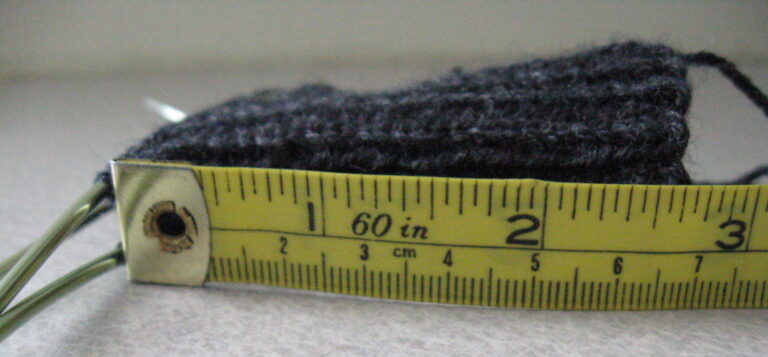
- Measure how many stitches you get over 4 inches (10 cm).
- Compare your results to the Typical Gauge column.
- Adjust your needle size up or down until your stitch count matches.
- Use our Knitting Gauge Calculator to predict how your personal tension will affect final garment dimensions. This step ensures your finished piece fits exactly as intended.
Why Needle Sizes Vary Between Brands
You may notice inconsistencies — for example, 7.0 mm needles are sometimes labeled US 10.75 and sometimes US 10½. This happens because:
- US sizing increments are not perfectly standardized
- Some sizes fall between traditional US steps
- Manufacturers label mid‑sizes differently
- Metric (mm) is the only universal measurement
For absolute accuracy, always rely on the metric size printed on the needle rather than the US label.