
Daily brushing with vet‑approved toothpaste is the single most effective way to prevent tartar buildup and avoid costly dental procedures. Start slow with puppies, keep seniors comfortable, and use chews or toys as supplements, but brushing is non‑negotiable. Done consistently, this routine can save you thousands in vet bills and keep your dog healthier for years.
Every time I see a friend or neighbor post about their dog’s upcoming dental cleaning, I see the price tags: $800, $1,000, sometimes up to $1,300. We have never had to take our dog in for a professional-cleaning, and it’s not because of good luck. It’s because of a crucial foundation of dental care that started before we even brought her home.
Author’s Note
This guide reflects our lived experience, which began with a puppy at four weeks old. We deeply respect that your journey, perhaps through adoption, is different.
While our starting points may vary, our shared goal is a healthy life for our dogs. Because every path is unique, this post is not a set of rigid rules but a collection of tools. Please adapt these routines to your dog’s specific age, temperament, and needs. We are simply offering the tools we’ve tested so you can pick and choose what works for you, no matter where your journey began.
When we first visited our dog’s breeder, we were fortunate to find someone who was truly serious about their dogs’ health. When we met the adult dogs, the first thing we noticed was their teeth. They were white, healthy, and had no visible tartar. This was our first lesson: a healthy mouth is a core part of a healthy dog.
That early start, combined with a consistent at-home routine, has saved us thousands of dollars and, more importantly, protected our dog’s overall health. Here is the complete guide to how we did it.
A Quick Note on Safety (Please Read This First)
This guide is a lifetime plan for prevention and at-home maintenance. But what if your dog’s teeth are already in bad shape?
If your dog’s gums are bright red, bleeding, or look severely receded, or if a tooth is visibly loose, you MUST SEE A VET FIRST. Attempting to scrape a painful, infected, or wobbly tooth at home can cause your dog extreme pain and will likely lead to a bite.
In these ADVANCED CASES, YOUR ONLY SAFE OPTION is an initial PROFESSIONAL VET CLEANING. Think of it as a “factory reset” for your dog’s mouth. Then, once their teeth are clean, you can use this guide as your comprehensive plan to ensure you reduce the chances of having to pay for that expensive cleaning.
Table of Contents
Dental Health: The Gateway to Your Dog’s Overall Health
Before we get into the “how,” we have to understand the “why.” A vet will tell you that a dog’s mouth is a gateway to the rest of its body. Poor dental health isn’t just about bad breath; it’s a serious medical concern.
By age three, over 80% of dogs show signs of periodontal disease (VCA Animal Hospitals, n.d.). This infection doesn’t just stay in the mouth.
- Heart Disease: Bacteria from infected gums (gingivitis) can enter the bloodstream, travel to the heart, and damage the heart valves, leading to serious cardiac conditions.
- Kidney & Liver Disease: The kidneys and liver act as the body’s filters. A constant flood of bacteria from a diseased mouth puts an enormous strain on these organs, and studies show a clear link between the severity of dental disease and organ dysfunction (American Veterinary Medical Association, n.d.).
- Pain & Behavioral Changes: A dog in dental pain can’t tell you what’s wrong. They may become irritable, avoid their favorite chew toys, or be reluctant to eat.
Preventative dental care isn’t cosmetic. It is a cornerstone of your dog’s long-term preventive health.
The Puppy Years: Setting the Foundation (Birth to 6 Months)
Our journey started when our puppy was just 4 weeks old. Puppies are born without teeth, and at that age, her tiny “milk teeth” were just beginning to erupt through her gums.
This is the most critical window to train a dog to accept handling. Our breeder gave us two non-negotiable rules.
Training Your Puppy to Accept Brushing
The first rule was to get the puppy used to having hands in its mouth. This is essential for bite inhibition (which is learned in the first six months) and for a lifetime of easy brushing.
His secret? Peanut butter on an extra-soft bristle toothbrush.
He would gently rub the peanut butter on the puppies’ gums with the brush. This built two positive associations:
- Hands in the mouth = a delicious treat.
- The toothbrush = a delicious treat.
Because of this early training, our dog has zero issues with me handling her mouth. She’s not just used to it; she enjoys it.
How to Handle Teething (and Prevent Destructive Chewing)
By the time she was 2 months old, her 28 “milk teeth” were in, and they were razor-sharp. We would affectionately nickname her our little “Velociraptor” because her tiny, sharp teeth were surprisingly painful during play, through no fault of her own!
From 3 to 7 months, she entered the main teething phase, where her baby teeth fall out to make way for 42 adult teeth.
It’s a common question: how do dogs go from 28 tiny teeth to 42 large adult teeth? It’s not a simple one-to-one replacement. The 28 baby teeth a puppy has are only the front and side teeth (incisors, canines, and premolars). They have no molars at all.
The jump from 28 to 42 happens in two parts:
- The 28 baby teeth fall out and are replaced by 28 permanent teeth.
- 14 brand-new adult teeth (10 molars and 4 premolars) grow in the back of the jaw where there was just empty space.
This entire intense process is what leads to the main teething phase. This is when puppies chew on everything. Their gums are itchy, swollen, and uncomfortable, and they are desperate for relief. This is why you hear horror stories from friends who lost shoes, furniture, walls, or even window trim to their new puppy.
We never had this issue, and it wasn’t just luck. We took preemptive measures to prevent destructive chewing before it ever started.
Our Anti-Chew Strategy:
- Soften Their Food: A puppy’s mouth is tender. We soaked her dry kibble in warm water to soften it. This not only eased any dental discomfort but also made it much easier for her young system to digest. For the first year, we always warmed her food before feeding.
- The Frozen Kong is Your Best Friend: This was our secret weapon. Instead of feeding her from a bowl, we portioned her moistened, soft food into several puppy-specific Kongs (affiliate link). It’s important to get the right size and the softer “puppy” rubber, not the harder adult version.
- Add Variety: To keep her highly interested, we’d mix in a spoonful of peanut butter, plain pumpkin puree, or mashed boiled vegetables like sweet potatoes. We put these ingredients on rotation, so she never got bored.
- Freeze Them: We’d pop the stuffed Kongs (affiliate link) in the freezer. Whenever we noticed her getting fussy or showing signs of gum discomfort, we would give her a frozen Kong.
- The Result: Peace and Pain Relief: The effect is immediate. Just like a cold ice pack relieves a human toothache, the frozen Kong soothes their inflamed gums. Better yet, the frozen puzzle lasts for hours, keeping her occupied, happy, and distracted. She was too busy working on her “pupsicle” to ever think about our furniture legs or wall corners.
This strategy not only saved our house but also taught her a vital lesson. During this key teething phase, we were able to redirect her natural instinct to chew onto a high-value, appropriate toy. She learned what to chew on, so she never had to guess.
The Great Tooth Transition: A Dog vs. Human Timeline
Because our breeder had us handling her mouth from day one, I was able to check her teeth daily during the teething phase. I learned very quickly that as soon as a tooth was loose, it was going to come out within the next day; and in the case of her last two teeth, within hours!
This daily, hands-on routine is how I was able to notice the transition in real-time.
The Teeth We Keep
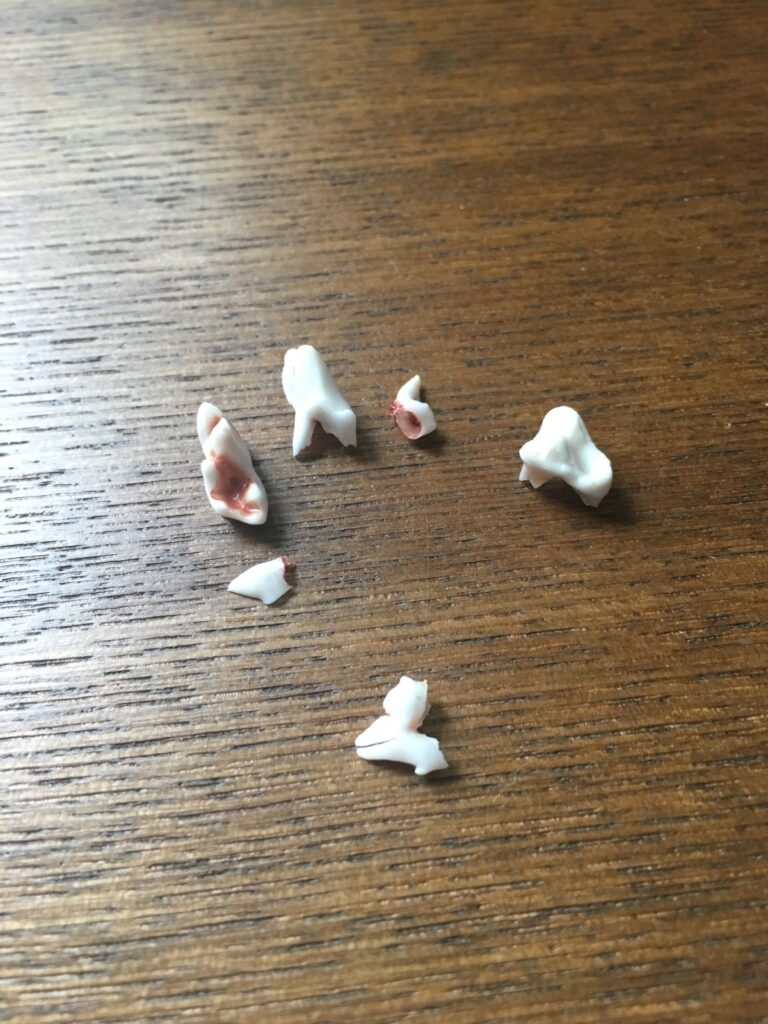
Most dog owners never see their puppy’s teeth fall out. They’re so small that they’re swallowed, lost in blankets, or vacuumed up without notice. But if you’re brushing daily, as we were, you’ll be the first to know. You’ll feel the looseness, see the tiny blood spot, and know your puppy is teething. This is not because a guide told you, but because you’re present.
During our daily brushing, I’d often notice a tooth barely hanging on, just a sliver of gum still holding it. Because she was so comfortable with my hands in her mouth, I could gently remove it before she swallowed it.
Yes, I still have most of our female Chessie’s milk teeth. I met her at four weeks old, brought her home at eight, and watched each tiny tooth fall out like a breadcrumb trail of her puppyhood. Keeping them wasn’t a decision made out of sentimentality alone; it was a way of witnessing her growth, of honoring the quiet, daily work of care.
Some people might find that strange, but it’s really no different than human parents who collect their child’s baby teeth for the “Tooth Fairy.” For us, it’s just a tangible reminder of that fleeting, precious time.
Dog vs. Human Teeth Development
It’s often helpful to compare our dog’s development to our own; it gives us a powerful perspective on what they’re going through. The biggest similarity is that both dogs and humans are diphyodonts, a scientific term meaning we get two sets of teeth: first, a “baby” (deciduous) set, and later, a permanent (adult) set (Veterinary Partners, n.d). For both of us, the baby teeth fall out and are replaced, and we both grow new molars in the back that never had baby versions.
But that’s where the similarities end. The most dramatic difference is the speed. A human child’s dental development takes more than a decade to complete. As you’ll see in the table, a puppy accomplishes this entire process, from having no teeth at all to a full, permanent set of 42 teeth in about seven or eight months.
This incredibly compressed timeline is why puppy teething is so intense and can be so destructive. They are replacing 28 teeth and growing 14 brand-new molars and premolars all at once (Merck Veterinary Manual, n.d.). Understanding this timeline is the key to understanding your puppy’s behavior.
| Development Stage | Dogs | Humans |
| Baby Teeth Eruption | 3 – 5 weeks old | ~6 months old |
| Number of Baby Teeth | 28 deciduous | 20 deciduous |
| Adult Teeth Eruption | 4 -7 months old | ~6 -12 years old |
| Number of Adult Teeth | 42 permanent | 32 permanent |
| Teething Behavior | Intense chewing, discomfort, behavioral shifts | Irritability, drooling, chewing |
| Full Dentition Age | ~7 months | ~12 years |
| Oral Care Needs | Daily brushing + regular at-home checks | Daily brushing + biannual dental checkups |
Visual Timeline: Your Puppy’s Dental Milestones
- Birth – 2 Weeks: No teeth.
- 3 – 5 Weeks: The 28 deciduous (baby) teeth erupt, starting with incisors.
- 8 Weeks (2 Months): All baby teeth are in. Time for that peanut-butter-on-a-toothbrush training!
- 12 – 16 Weeks (3-4 Months): The “tooth fairy” starts visiting. Baby teeth begin to fall out, starting with the incisors.
- 4 – 7 Months: The permanent teeth erupt. The 42 adult teeth (molars, premolars, canines, incisors) push out the baby teeth.
- 7 – 8 Months: The transition is complete! Your dog now has its full set of 42 adult teeth.
How 28 Baby Teeth Become 42 Strong Adult Teeth
The most fascinating part of this transition is how a dog goes from 28 baby teeth to 42 permanent adult teeth. It’s not a simple one-to-one replacement.
- The 28-for-28 Swap: The 28 baby teeth a puppy has (incisors, canines, and premolars) all fall out and are replaced by 28 permanent teeth.
- The “New” 14 Teeth: The jump from 28 to 42 comes from 14 brand-new adult teeth (10 molars and 4 premolars) that grow in the back of the jaw where there was just empty space (Merck Veterinary Manual, n.d.).
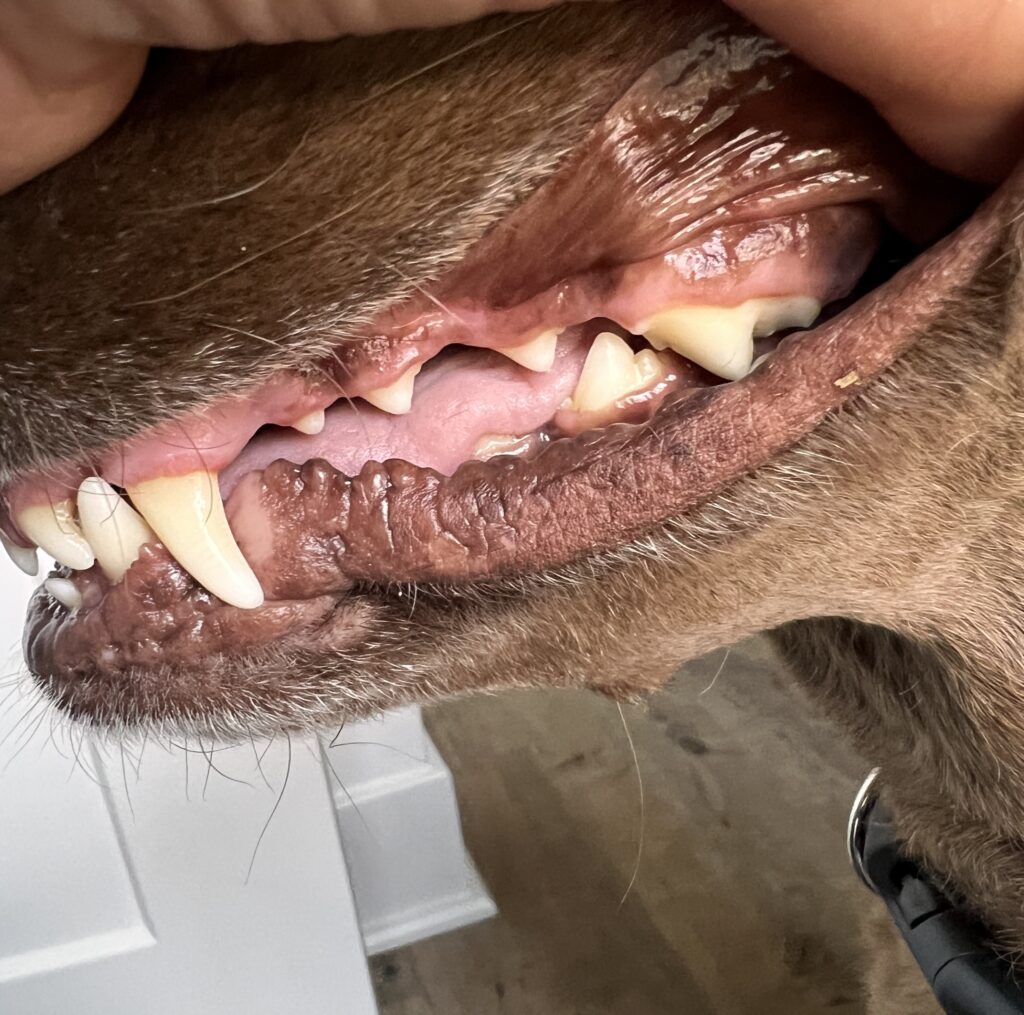
These new adult teeth are incredibly strong, not just because of the powerful jaw muscles (like the temporalis and masseter), but because of their design. Like humans, a dog’s teeth are deeply embedded in the jaw bone (maxilla and mandible). They aren’t fused to the bone, but rather sit in a deep socket (alveolus) and are held in place by a shock-absorbing periodontal ligament (AAHA, 2019).
The visible crown of a dog’s canine tooth is just the “tip of the iceberg”; the root is often more than twice as long, anchoring it deep in the jaw. This is what gives them such a strong, stable bite.
Caring for Your Senior Dog’s Teeth (Ages 7+)

That foundation of care we built in the puppy stage has paid off immensely in our dog’s senior years. Our dog, Buddy, is now 10 years old and he still has all 42 of his permanent teeth. He has not lost a single one.
However, senior dogs have new challenges. Their gums become more sensitive, just like in humans. A few years ago, when we first noticed some bleeding and couldn’t figure out the cause. For a week, we took note of everything that went into his mouth and checked his gums afterward.
Then it occurred to us: it was his hard, dry kibble. Have you ever only eaten dry, hard food? Imagine eating crunchy cereal or hard pretzels for every meal. Over time, this can be rough. For a senior dog with already sensitive gums, that hard kibble can be painful and aggravate inflamed tissue, causing bleeding (American Animal Hospital Association, n.d.).
The solution was simple: we soak his dry food in a little warm water. This softens it, making it easy to eat and gentle on his gums, while still providing the nutrition he’s used to.
The Long-Term Economics of At-Home Care
When you consider that the cost of one $800 professional cleaning could pay for 15-20 years of at-home toothpaste and supplies, the economic argument is overwhelming. This is the very definition of a “Buy It For Life” investment in your pet’s health.
The cost table makes the financial benefit clear, but the long-term value is even better. The primary annual cost of at-home care is for replaceable items like toothpaste. The main tools, like a high-quality metal dental scaler kit (affiliate link), are a one-time purchase that will last for your dog’s entire life.
A Note on ‘Anesthesia-Free’ Cleaning
You may see groomers offering a cheaper ‘anesthesia-free’ scaling. We do not recommend this. This is a purely cosmetic procedure that only scrapes the visible part of the tooth.
It does not (and cannot) clean under the gumline where the real disease is, and it can be a very stressful and unsafe experience for the dog. True dental health must be done either safely at home (like our maintenance) or properly under anesthesia by a vet.
The Cost of Dental Care: At-Home vs. Professional
| Care Type | At-Home Routine | Professional Vet Cleaning |
| Cost | $20 – $50 / year | $350 – $1,300+ / session |
| Includes | Dog-safe toothpaste, toothbrushes, dental scaler (for tartar), dental chews. | Pre-op bloodwork, IV fluids, general anesthesia, ultrasonic scaling, polishing, dental X-rays. |
| Frequency | Brushing: 3-5x/week. Deep Clean: 2x/year. | Typically 1x/year (or as-needed). |
| Pros | Inexpensive, non-invasive, maintains health. | Only way to clean below the gumline and treat advanced disease. Necessary if tartar is severe. |
| Cons | Can’t fix severe disease. Requires training. | Expensive, requires general anesthesia (which always carries a risk). |
Diet: The Other Side of At-Home Dental Care
Brushing is what you do, but what you feed them is just as important. Being mindful of what our dogs eat is a huge part of our dental health strategy.
The biggest culprits for poor dental health (beyond not brushing) are sugars and starches, which feed the bacteria that cause plaque. This is why we are very strict about “people food” and trendy treats.
For example, our dogs never get a “Starbucks Puppaccino” (which is just a cup of sugary whipped cream) or any foods with artificial sweeteners. The only sugar they get is the natural, incidental kind from healthy, whole-food snacks like a bit of banana or a slice of apple (which is also crunchy and helps scrape teeth).
A Note on Soft Treats: If we want to give them a soft treat or a moist food topper, we avoid store-bought applesauce, which is often loaded with high-fructose corn syrup. Instead, we make our own Sugar-Free Applesauce using Red Delicious apples. It has zero added sugar, just pure fruit, making it a safe, hydrating addition to their bowl that won’t stick to their teeth like sugary syrups do.
This mindfulness also applies to their main meals. Many owners believe hard, dry kibble helps “clean” a dog’s teeth, but this is largely a myth. Most kibble is high in carbohydrates, which break down into sugars and can actually stick to the teeth, feeding plaque (Clarke, 2020). This is another reason we soak our senior dog’s food: it’s not only gentler on his gums, but it also prevents starchy, dry bits from getting packed into the crevices of his molars.
Passive Maintenance: The Truth About Dental Chews (Like Greenies)
This is one of the most common mistakes we see owners make. It is tempting to believe that This is one of the most common mistakes we see owners make. It is tempting to believe that giving your dog a daily dental chew that claims to “brush” their teeth is a replacement for actual physical brushing.
It is not. Dental chews do not work alone.
We want to caution against thinking that dental chews replace the primary method of dental care. We tried this route, and found two major problems:
- They are costly. A daily dental chew adds up quickly.
- They don’t last. We found our dogs would chew them a few times and then just swallow them. They simply aren’t in the mouth long enough to provide a meaningful, abrasive “brushing” action.
Our philosophy is that dental chews and other passive products should be regarded as supplements, not a replacement. They are the last thing to add to your routine, not the first.
If you do offer them, here’s what to look for:
- VOHC Seal: Look for the VOHC (Veterinary Oral Health Council) Seal of Acceptance on the package. This means the product has been scientifically proven to help reduce plaque or tartar (American Veterinary Medical Association, n.d.).
- Water Additives: This is an easier passive step. You can add a capful of a dog-safe dental water additive to their water bowl. It’s tasteless and helps kill the bacteria that cause plaque every time they take a drink.
But remember, these are just supplemental. Nothing replaces the mechanical action of brushing.
Help! My Dog’s Teeth Are Already Bad (And I Can’t Afford the Vet)
This is the situation many people find themselves in. We had a neighbor with a Golden Retriever who had terrible breath because of years of tartar buildup. You could see the thick, brown tartar when the dog opened its mouth. We wanted to say hi, but the dog’s breath was just foul.
It’s easy to look at a situation like that and feel overwhelmed, or that it’s “too late.” We also know that a $1,000+ vet bill is simply not an option for most people, especially these days when just getting food in the refrigerator is a struggle.
It is never too late to start.
The tools we use cost very little in comparison to a vet visit. The most important things you need are patience, gentleness, and consistency.
The “One Tooth a Day” Plan
Don’t try to fix years of neglect in one afternoon.
- Start in small sessions. Your goal for the first week is to just get your dog comfortable with the idea of you working in their mouth (see the hand-feeding guide in the next section).
- Clean one tooth a day. That’s it. Just one.
- Be gentle. Don’t be forceful. This is a life-changing thing you’re doing for your dog, and it needs to be a positive, trusting experience.
- If you clean just one tooth every day, in about a month and a half, your dog will have cleaner teeth, better breath, and will be on the path to better health.
Pro-Tip for “Concrete” Tartar: The ‘Scoring’ Method
When you face tartar that is as thick and strong as concrete, our advice is not to use “Herculean force.” In fact, the opposite is true.
Instead of trying to “pop” the whole piece off, we use the sharp tip of our metal scaler to “score” the tartar. This means we gently make little cuts (like you’re scoring bread dough) across the surface. This helps to split up the structural integrity of the tartar, making it easier to gently flick off in smaller pieces. We focus on the corners and edges first.
Help! How to Start Brushing an Adult Dog’s Teeth
This guide is for everyone, especially if you’re starting with an adult dog who’s never had his teeth brushed. You must have patience and lower your expectations. This will be a multi-phase process.
Phase 1: The Life-Saving Skill of Hand-Feeding
Before you even think about a toothbrush, your dog must be 100% comfortable with your hands in and around their mouth. The best way to do this is by hand-feeding.
This is more than just a prep step for brushing, it’s a potentially life-saving skill. Suppose you take your pup on a walk and they see something interesting and start eating it. You have to be able to safely open their mouth and remove the item. When my dog was a puppy, she would pick up things she shouldn’t, and I had no trouble getting her mouth to open so I could pull the item out before she swallowed it. This simple training can save you a multi-thousand dollar emergency vet visit, a save that’s even bigger than our $13 Breville oven fix that saved us from replacing a $400 appliance!
How to Do It: Several times a day, hand-feed your dog. This can be high-value treats or even their entire meal, one handful at a time. Your dog will learn that your hand near their mouth is a source of good things, not a threat. Over time, your hand will become less interesting than the food you are offering.
The Payoff: Strength vs. Learned Gentleness
It’s amazing to watch our dogs be so gentle with our hands, especially when you know their bite is so strong. This is the difference between physical potential and learned control.
- Their Strength (Physical): As we covered, a dog’s bite is powerful due to their large jaw muscles and deeply rooted teeth. This is their “hardware.”
- Their Gentleness (Mental): Their ability to be gentle is learned. This is “bite inhibition.” By hand-feeding and constantly handling their mouths as puppies, you teach them that human skin is fragile. Their brain develops an incredible sense of pressure control (proprioception). They know the difference between a chew toy and your finger and can make micro-adjustments in real-time. This is why our trained dogs are so gentle.
In the video below, you’ll see how our dog uses her tongue to my fingers out of her mouth. She lowers her jaw just enough to almost touch my fingers and I don’t feel her teeth.
Phase 2: Introducing the Toothbrush
Once your dog is comfortable with your hands, introduce the toothbrush. Don’t try to brush.
- Let them sniff the toothbrush.
- Put a high-value treat on it. Dog toothpaste comes in flavors they love, like the Petrodex Dental Care Kit with Peanut Flavor (affiliate link) or other enzymatic toothpaste kit (affiliate link) that include finger brushes and sprays. (Remember, never use human toothpaste, as most contain Xylitol which is toxic to dogs).
- Let them just lick the treat off the brush. Do this for several days. The goal is to associate the brush itself with a reward.
(As an Amazon Associate, I earn from qualifying purchases.)
Phase 3: The First Brush (Be Patient!)
Now you can combine the steps.
- Let them lick the toothpaste off the brush.
- As they do, gently lift their lip.
- Gently brush one tooth. Just one. Then stop and give them lots of praise.
- The next day, try for two teeth. The day after, try for 5 seconds.
- Slowly increase the duration. This is a marathon, not a sprint. You are trying to build a positive habit for life, not win a battle.
Our At-Home Dental Care Routine
Once your dog is comfortable with you handling their mouth, you can start a routine. Our routine has two parts: a simple, daily habit, and a more thorough bi-annual deep clean.
Our Daily Brushing Routine (The 60-Second Habit)
This is the most important part of our entire dental plan. It’s not a 10-minute scrub; it’s a 60-second daily habit focused on consistency.
But how you brush is critical. The common back-and-forth “scrubbing” motion can actually damage your dog’s sensitive gums. In our video, we demonstrate the gentle, vertical stroke that is safer and much more effective.
As you can see in the video, the technique is more important than the tool.
We use an extra-soft bristle toothbrush and a dog-safe toothpaste. But what type of brush is best? You’ll see several main kinds:
- Finger Cot/Brush: A small rubber cap with bristles that goes over your finger.
- Straight Brush: Similar to a human toothbrush, often with two heads.
- Angled Brush: Has a bend in the handle to help reach the back teeth.
We have used all of them and have found that the type of brush doesn’t matter nearly as much as your consistency. The best tool is simply the one you are most comfortable with and that your dog accepts. The effectiveness is all in the technique.
The Correct Brushing Stroke: Just as we show in the video, the most effective method is a gentle up-and-down (vertical) stroke, starting at the gumline and brushing away from it.
⚠️ DO NOT use a back-and-forth (horizontal) scrubbing motion. This can be abrasive, can damage their sensitive gums over time, and it doesn’t clean the gumline (the most important part) very well.
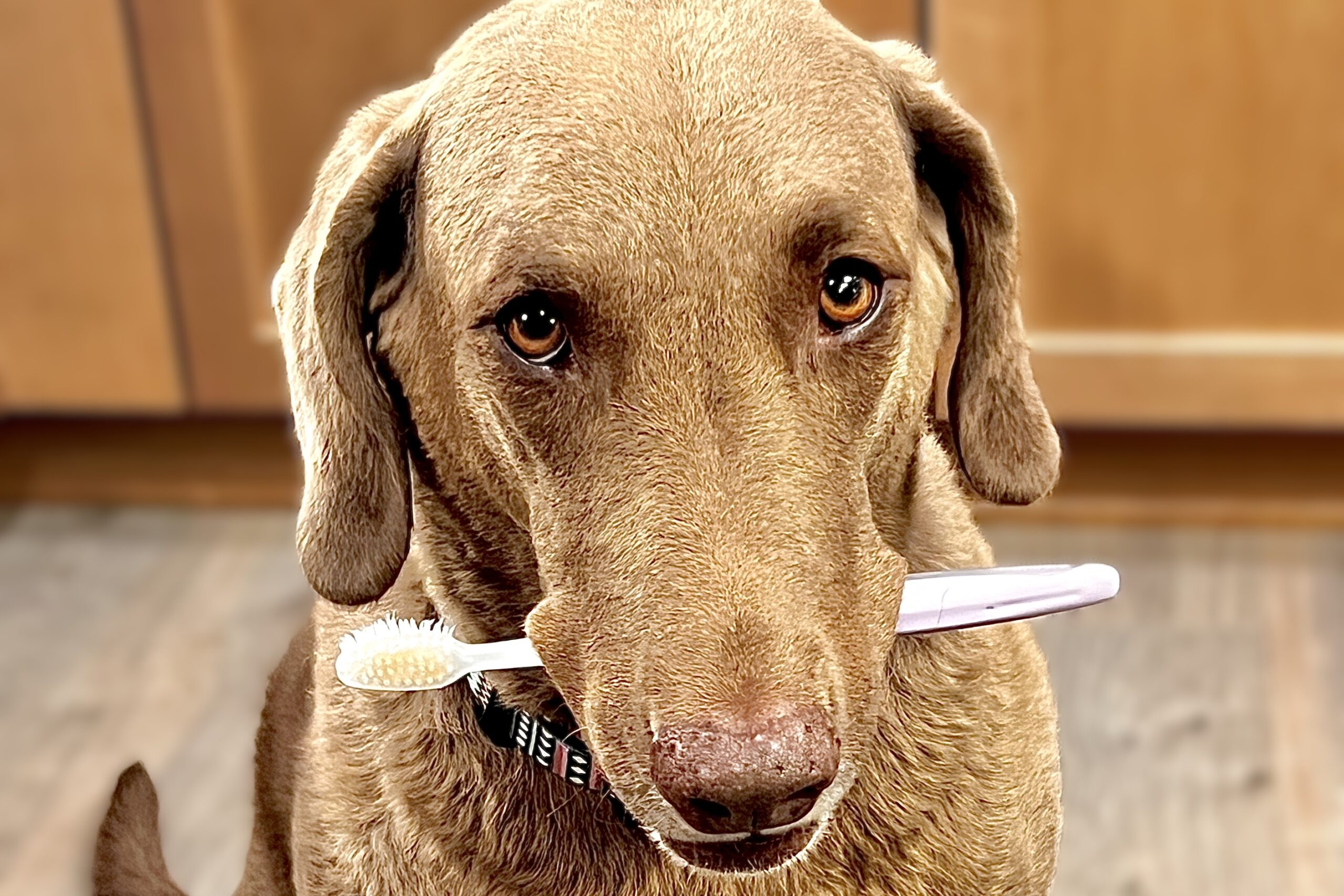
Once you have the right technique, the key is just finding a tool you’re comfortable with and a toothpaste flavor your dog loves. Our female Chessie, in particular, wants to chomp on the toothbrush, I think she just loves the flavor!
A Note on Sneezing You may notice your dogs sneeze every time you brush their front teeth (the incisors). This is a very common and harmless reflex! The nerves in the upper gums and the roof of the mouth are closely connected to the nasal passages. Brushing this ticklish area often triggers a sneeze. It’s not a sign of pain, just a quirky, involuntary reaction. Our dogs do it all the time.
Pro-Tips for Tricky Spots The real challenge is brushing the lower teeth, as their instinct is to clench their mouth closed. Here are two methods we use:
- The “Nudge” Method: To get their mouth open, we gently place our fingers on the shortest teeth (incisors or premolars) and apply a little nudge.
- The “Toy” Method: We have them hold a favorite chew toy. This props their mouth open just enough to get the toothbrush to the inside (tongue-side) of the teeth.
Our 6-Month “Spaw Day” Deep Clean (The Advanced Routine)
Our secret to avoiding that $1,000 vet bill is a thorough cleaning every six months. This is a crucial, recurring appointment, so I mark it on our 2026 bird wall calendar right alongside our own check-ups to ensure we never forget.
I call this routine our “Spaw Day.” The dogs get a full body massage, their nails trimmed, and extra fur brushing.
After a massage, brushing, nail trim, and once the dogs are fully relaxed, we check every single tooth and perform two advanced steps.
Advanced Technique: The Dental Scaler
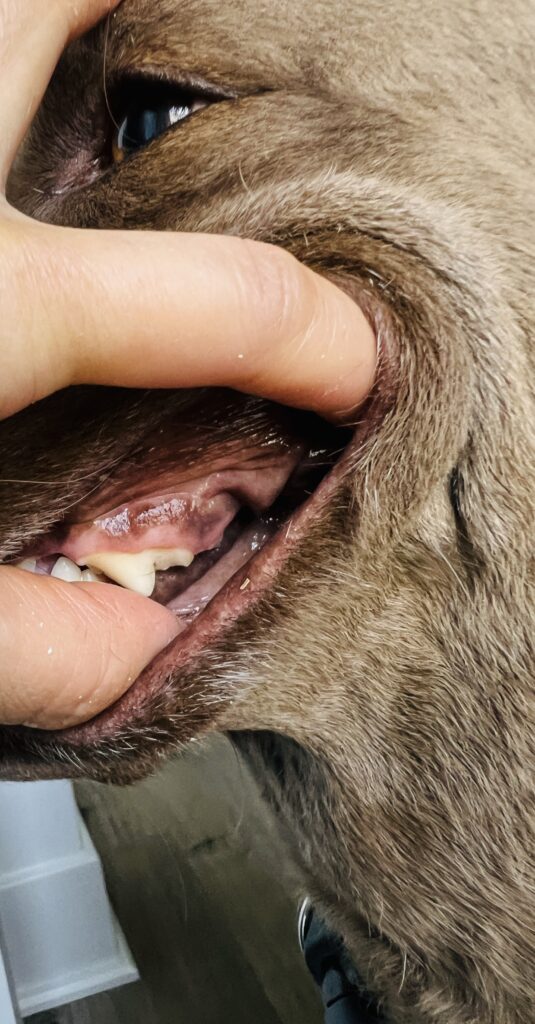
The most important part of my deep clean is focusing on the upper carnassial tooth (the large, upper fourth premolar).
This tooth is designed for shearing and has a natural groove that catches food, which is where tartar builds up first. To manage this, we use a dental scaler.
Our vet originally recommended using a plastic scaler like this one from Bogadent (affiliate link) to scrape the tartar. This is a very safe way to start, and I highly recommend it for any beginner. It gets you (and your dog) used to the tool and the motion without the risk of accidentally causing harm.
However, you’ll eventually find that stubborn tartar that just won’t budge with plastic. As I got used to handling the tool and gained confidence in my control, I graduated to using a metal dental scaler kit like this one (affiliate link).
My “A-ha” Moment & The Correct, Safe Technique: I learned how to do this safely by paying close attention during my own dental cleaning. My hygienist’s technique was my “a-ha” moment. The entire method is about protecting the gums.
- Our Method: We are extremely careful to NEVER point the sharp tip toward the gumline. We always point it away from the gums, toward the biting surface of the tooth.
- The “U” Analogy: We think of a single tooth as the letter ‘U’. We angle the scaler tip towards the end of the ‘U’ (the chewing part). The curved, blunt side of the scaler tip is always the part that is facing the gumline.
- Be Patient: We gently place the thinner, sharp edge on top of the visible tartar and gently “flick” or scrape one little piece at a time. We do not expect it all to come off in one go.
- ⚠️ Disclaimer: This technique is for visible, above-the-gumline maintenance only. Any serious, dark tartar below the gumline must be handled by a veterinarian.
Our Advanced “Spaw Day” Tip: Flossing
This might sound advanced, but we also floss our dog’s teeth. This started one day when my dog was watching me floss and she seemed genuinely interested in what I was doing.
On a whim, I took a piece of unflavored, waxed floss (affiliate link) and tried it on her. I gently glided it in the interdental spaces (the gaps) between her large premolars and molars, the side teeth where food gets stuck. To my surprise, she didn’t seem to mind and even wagged her tail.
The key, like with all dental care, is to be very gentle and never force it. We are not aggressively “snapping” the floss against the gumline. We’re just gliding it to remove any trapped food. Some days she’s not into it, so I skip it.
My trick to get her interested? I’ll take the unflavored floss and spread a tiny bit of peanut butter on it, then wipe most of it off with a napkin. This leaves just the scent. For all she knows, it’s a peanut butter-flavored treat, and she’s all about it.
Our Complete At-Home Dental Care Checklist
This is the simple checklist you can follow, based on our own experiences and things we’ve learned along the way, to help maintain your dog’s dental health.
- [ ] Start Early: If you have a puppy, handle their mouth, touch their gums, and make it a positive experience (like our breeder did) within the first 6 months.
- [ ] Brush Regularly: Aim for 3-5 times a week, ideally daily. A 30-second brush on the outside (cheek-facing) surfaces of the teeth is a great start.
- [ ] Use the Right Tools: Only use dog-safe toothpaste. A soft-bristle human toothbrush or a dedicated dog toothbrush works fine.
- [ ] Check for Problems: Once a month, “flip the lip” and look for these warning signs:
- Bad breath
- Red, swollen, or bleeding gums
- Yellow/brown tartar buildup
- Broken or loose teeth
- [ ] Supplement, Don’t Replace: Use safe dental chews (look for the VOHC seal) as a supplement to, not a replacement for, regular brushing.
- [ ] Get an Annual Vet Check: Your veterinarian should check your dog’s teeth at their annual exam. They are your partner and can tell you if and when a professional cleaning under anesthesia is necessary (American Veterinary Medical Association, n.d.).
Our At-Home Dental Care Shopping List
Here is a quick list of the types of products we’ve found helpful in our at-home routine. (As an Amazon Associate, we earn from qualifying purchases.)
- Puppy Teething Toy: Puppy-Specific Kong Dog Toy
- Puppy Stuffable Dog Toy: Puppy-Specific Kong Stuffable Dog Toy
- Enzymatic Toothpaste: Petrodex Dental Care Kit (Peanut Flavor)
- Toothpaste/Brush Kit: Enzymatic Toothpaste Kit with Finger Brush for Dogs
- Beginner Scaler: Bogadent Plastic Tartar Remover
- Advanced Scaler: G.CATACC Metal Dental Scaler Kit
- Floss: Unflavored Waxed Floss
Your Top 10 Dog Dental Care Questions Answered
These answers reflect what worked for us. Every dog is different, so use them as starting points and consult your vet for personalized care. Advanced techniques (like scaling or flossing) are optional and best for owners already confident with brushing.
Why does my dog’s breath smell so bad?
Bad breath is the most common sign of dental disease, caused by bacteria. As we cover in “Dental Health: The Gateway to Your Dog’s Overall Health,” this bacteria can lead to serious heart and kidney issues if ignored.
How often should I brush, and why does my dog sneeze when I do?
We recommend a 60-second daily habit, focusing on the vertical, up-and-down stroke we demonstrate in “1. Our Daily Brushing Routine (The 60-Second Habit).” And if your dog sneezes when you brush their front teeth, don’t worry! As we explain in “4. A Note on Sneezing,” it’s a common, harmless reflex because the nerves in their upper gums are so close to their nasal passages.
Why is brushing so much better than just giving my dog dental chews?
Chews are a supplement, not a replacement. As we found in “Passive Maintenance: The Truth About Dental Chews,” they don’t last long and can’t clean the gumline, where disease starts. Only a toothbrush can mechanically remove plaque.
My adult dog hates having his teeth brushed. Is it too late to start?
It is never too late, but the key is patience and a phased approach. Our “Help! How to Start Brushing an Adult Dog’s Teeth” section details a 3-phase plan that starts with gentle hand-feeding to build trust, long before you even introduce a toothbrush.
My dog has heavy, brown tartar. What can I do if I can’t afford the vet?
For mild, visible tartar, you can start a “one-tooth-a-day” plan, which we detail in “Help! My Dog’s Teeth Are Already Bad.” We also share our “scoring” method for stubborn spots.
⚠️But safety first: If gums are red, bleeding, or teeth are loose, stop and see your vet. This guide is for maintenance, not advanced disease.
My puppy is chewing and destroying everything! What can I do?
This is a normal part of their intense teething phase. As we explain in “How to Handle Teething (and Prevent Destructive Chewing),” their gums are sore because 28 baby teeth are being replaced by 42. Our “Anti-Chew Strategy” using a frozen Kong is a lifesaver for this.
Are “anesthesia-free” dental cleanings a good (and cheaper) option?
We do not recommend this, as it’s a purely cosmetic procedure. As we explain in our “The Cost of Dental Care: At-Home vs. Professional” section, it’s stressful for the dog and, most importantly, cannot clean under the gumline, which is where the real disease lives.
Is it really safe to remove tartar at home with a scaler?
This is an advanced technique for maintenance, not for advanced disease, and you must be careful. As we show in “Advanced Technique: The Dental Scaler,” we started with a plastic scaler and only graduated to a metal one after gaining confidence. Our post details the safe “A-ha Moment” technique we learned to never point the sharp tip toward the gums.
⚠️Note: If gums are red, bleeding, or teeth are loose, stop and consult your vet. This step is optional and best for owners already confident with brushing.
My senior dog’s gums are bleeding. Is their food too hard?
It’s very possible, as senior dogs have more sensitive gums. You can read about our discovery in “Caring for Your Senior Dog’s Teeth (Ages 7+).” Our simple solution was to start soaking his dry kibble in warm water to soften it, which is much gentler on his mouth.
You’re not really supposed to floss a dog’s teeth, are you?
It’s an optional, advanced step, but we find it very effective for removing food trapped between the molars. As we show in “5. Our Advanced ‘Spaw Day’ Tip: Flossing,” we are very gentle and never force it. We also use a “peanut butter scent” trick to make our dogs see it as a treat.
⚠️Note: Focus on brushing first. Flossing is only for dogs already comfortable with a routine.
References
American Veterinary Medical Association (AVMA). (n.d.). Pet dental care. https://www.avma.org/resources-tools/pet-owners/petcare/pet-dental-care
American Animal Hospital Association (AAHA). (2019). Anatomy & pathology. https://www.aaha.org/resources/2019-aaha-dental-care-guidelines-for-dogs-and-cats/anatomy-pathology-2/
Veterinary Partner (VCA) (n.d). Dog Dental and Oral. https://veterinarypartner.vin.com/default.aspx?pid=19239&catId=254090&ind=85
VCA Animal Hospitals. (n.d.). Dental disease in dogs. VCA Hospitals. https://vcahospitals.com/know-your-pet/dental-disease-in-dogs
Veterinary Partner (VCA) (n.d). Toothbrushing and Dental Prophylaxis in Cats and Dogs
https://veterinarypartner.vin.com/default.aspx?pid=19239&catId=254090&id=4951286
American Animal Hospital Association. (2024). A Watchful Eye: Recognizing Senior Pet Health Problems. https://www.aaha.org/resources/a-watchful-eye-recognizing-senior-pet-health-problems/
Chandler, M. (2017). Chew on This: Dentistry and Nutrition: Dental Disease and Diet; The Nutritionist View. WSAVA 2017 Congress. Veterinary Information Network (VIN). https://www.vin.com/apputil/content/defaultadv1.aspx?pId=20539&id=8506271
Merck Veterinary Manual. (n.d.). Dental Development of Dogs. https://www.merckvetmanual.com/dog-owners/digestive-disorders-of-dogs/dental-development-of-dogs?_gl=11c744xq_upMQ.._gaOTM2NDg0NzYyLjE3NjMyNTQ0MTA._ga_HM7HGJFRVG*czE3NjMyNTQ0MDkkbzEkZzAkdDE3NjMyNTQ0MDkkajYwJGwwJGgw